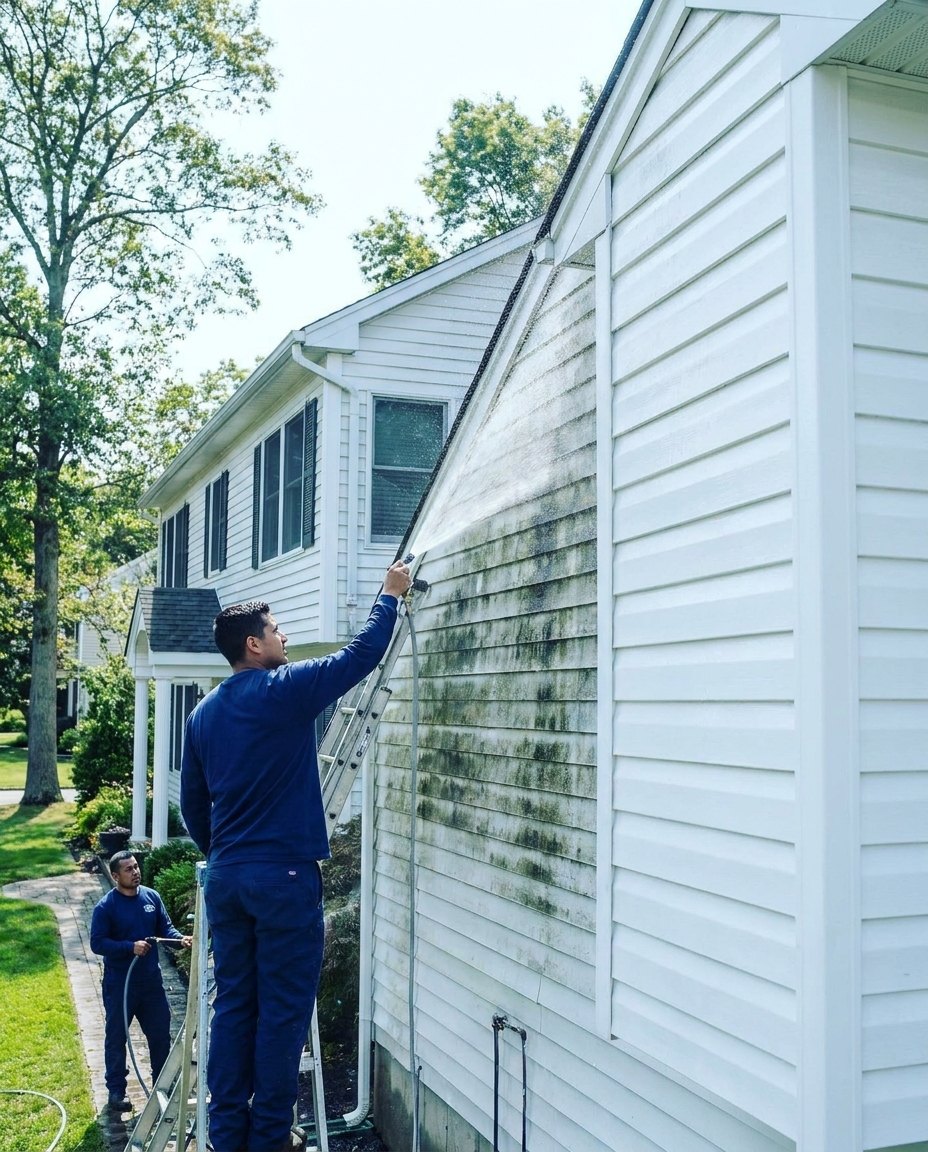
Green algae and black mildew are the most common stains on Long Island siding. Here is how to remove them safely, what actually kills the growth, and how to keep it from coming back.
- That green film is usually algae; black speckles are mildew. Both feed on moisture and shade.
- A soft wash with a bleach-based solution kills the organism. High-pressure blasting only spreads it and can damage siding.
- North Shore tree cover and South Shore salt air both keep Long Island siding damp, so growth returns without prevention.
- Work on a cool, overcast day, protect your plants, and never point a pressure washer up under the siding laps.
Is it algae or mildew? Know what you are fighting
The green coating that creeps up the north and shaded walls of most Long Island homes is almost always algae, usually a hardy type called Gloeocapsa magma. It shows up as a green or greenish-black film, and it loves the same conditions our island offers in spades: humidity, shade, and surfaces that stay damp for hours after rain or morning dew.
Mildew is different. It appears as small black or gray speckles and fuzzy patches, often in corners, under eaves, and behind downspouts where air does not move. A quick field test helps you tell them apart: dab a hidden spot with a little household bleach on a rag. If the stain lightens within a minute, it is organic growth (algae or mildew). If nothing changes, you are likely looking at dirt, pollen, or oxidation instead.
Knowing which one you have matters because the fix is nearly identical, but the failure points differ. Algae spreads across broad sunless walls, while mildew hides in tight, poorly ventilated pockets. If you only clean the obvious green streaks and ignore the shaded corners, the mildew left behind will reseed the whole wall within a season.
Why Long Island siding grows algae in the first place
Long Island gives algae almost everything it wants. On the North Shore, mature oak and maple canopies keep walls shaded and drop a steady layer of organic debris and pollen that feeds growth. Homes tucked into wooded lots in places like Huntington, Smithtown, and Cold Spring Harbor often see the heaviest green staining on their north and east walls.
On the South Shore, from Long Beach to the Great South Bay towns, it is salt air and near-constant humidity doing the work. Salt is hygroscopic, meaning it pulls moisture out of the air and holds it against the siding, so surfaces rarely dry out fully. Add our humid summers, wet springs, and the moisture that lingers after a nor'easter, and you have a year-round greenhouse for algae and mildew.
Vinyl siding, the most common cladding on Long Island homes, has a slightly textured surface and horizontal laps that trap water and spores. Fiber cement and painted wood are not immune either. Anywhere sprinklers overspray the wall, a gutter overflows, or shrubs crowd the foundation, you will see growth take hold first.
Soft wash, not pressure blast: the right method
The single most important thing to understand is that killing algae is a chemistry job, not a pressure job. Professionals call the correct approach soft washing: applying a cleaning solution that kills the organism at the root, letting it dwell, then rinsing with low pressure. This is very different from firing a 3,000 PSI pressure washer at your walls.
High pressure feels satisfying, but on siding it causes real harm. A narrow, high-pressure stream can crack or chip vinyl, gouge painted wood, and, worst of all, drive water up behind the laps and into the wall cavity where it soaks insulation and framing. That trapped moisture can lead to hidden mold and rot long after the green is gone. It also strips the organism off the surface without killing it, so the algae simply regrows from spores left in the texture.
A soft wash does the opposite. The solution kills algae and mildew down to the root, so you remove the stain and the living colony in one pass. The result lasts far longer, typically a year or more on Long Island, versus a few months for a pressure-only rinse. When you see a company advertising house washing here, this dwell-and-rinse method is what you should expect them to use on siding.
Step by step: cleaning the siding yourself
If you want to tackle a manageable, ground-level wall yourself, here is a safe DIY approach. Mix a cleaning solution of roughly one part household bleach (sodium hypochlorite) to three or four parts water, and add a small squirt of dish soap to help it cling. For tougher stains you can go a little stronger, but stay in that range. Work on a cool, overcast day so the solution does not evaporate before it can work; direct summer sun dries it too fast.
First, protect your surroundings. Thoroughly wet down every plant, shrub, and patch of grass near the wall before you start, and rinse them again afterward. Bleach solution will scorch foliage if it dries on the leaves. Cover delicate plantings with plastic if you can, and close nearby windows. Wear eye protection, gloves, and old clothes.
Apply the solution with a pump sprayer from the bottom up to avoid streaks, working in sections you can reach comfortably. Let it dwell for five to ten minutes, but do not let it dry on the siding. Gently agitate stubborn mildew spots with a soft-bristle brush on a pole. Then rinse thoroughly from the top down with a garden hose or a pressure washer set to a wide, low-pressure tip (a 40-degree nozzle or a dedicated soft-wash setting). Keep the stream angled slightly downward so water never drives up under the laps.
Keeping it from coming back
Cleaning removes the growth, but prevention decides how long your walls stay clear. Start by cutting off the moisture supply. Trim back shrubs and tree branches so air and sunlight reach the siding, and aim for at least a foot of clearance between plantings and the wall. More airflow means the surface dries faster, and dry siding does not grow algae.
Fix the water sources you control. Adjust sprinkler heads that spray directly onto the house, clean your gutters so overflow does not sheet down the walls, and make sure downspouts carry water away from the foundation. On the South Shore especially, giving salty, humid air a chance to dry off the wall between wettings makes a real difference.
A yearly maintenance wash is the most reliable defense on Long Island. Most homes here benefit from a soft wash once a year, ideally in late spring after pollen season or early fall, which keeps colonies from ever getting established. Homes under heavy North Shore tree cover may want it more often. A standing annual appointment, whether you do it yourself or hire a local company like Premium Services, is far cheaper and easier than reversing years of buildup.
When to call a professional (and what it costs)
DIY works well for a single shaded wall you can reach from the ground. But there are clear moments to hand it off. Second-story walls, steep gable ends, and anything that needs a ladder over concrete are genuine fall risks, and mixing bleach solutions at height while managing a hose is how people get hurt. If the growth covers most of the house, keeps returning, or sits on delicate surfaces like cedar shakes or older painted wood, a pro with the right soft-wash equipment will get a safer, more even result.
As a rough guide, professional house washing on Long Island typically runs somewhere in the low hundreds of dollars for a small ranch or Cape and can reach the mid-hundreds or more for a large two-story Colonial. Prices vary with the square footage of siding, the number of stories, how heavy the growth is, and access around the property. Beware of quotes that sound too cheap, as they often mean high-pressure blasting that can void your siding warranty.
Premium Services is licensed and insured and works throughout Nassau and Suffolk County, using soft-wash methods matched to your siding type. If you would rather skip the ladder and the chemistry, you can call (934) 500-2940 for a quote or book online. Whether you hire out or do it yourself, the goal is the same: kill the growth at the root, protect your landscaping, and never let high pressure force water where it does not belong.
Frequently asked questions
Not when it is diluted properly and rinsed off. A solution of about one part household bleach to three or four parts water is safe for vinyl. The key is to wet your plants first, keep the solution off dry foliage, and rinse the wall thoroughly when you finish.
Once a year is right for most Long Island homes, ideally in late spring or early fall. Homes under heavy North Shore tree cover or in very humid South Shore spots may need it a bit more often to stay ahead of the growth.
You can strip the visible green, but you will not kill the algae, so it grows back within months. High pressure also risks cracking siding and driving water behind the laps. A bleach-based soft wash kills it at the root and lasts far longer.
That wall probably stays damp and shaded, which is exactly what algae needs. Trim nearby shrubs and branches for airflow and sunlight, fix any sprinkler or gutter overspray, and a yearly maintenance wash will keep it from re-establishing.
For a low, reachable wall, DIY is fine. For second-story walls, whole-house growth, or delicate surfaces, a licensed and insured pro like Premium Services is safer and gets a more even, longer-lasting result. Call (934) 500-2940 for a quote.
Rather leave it to the pros?
Premium Services covers all of Long Island. Free, no-obligation estimate.
Pressure Washing near you
Get it done by a local, licensed team.