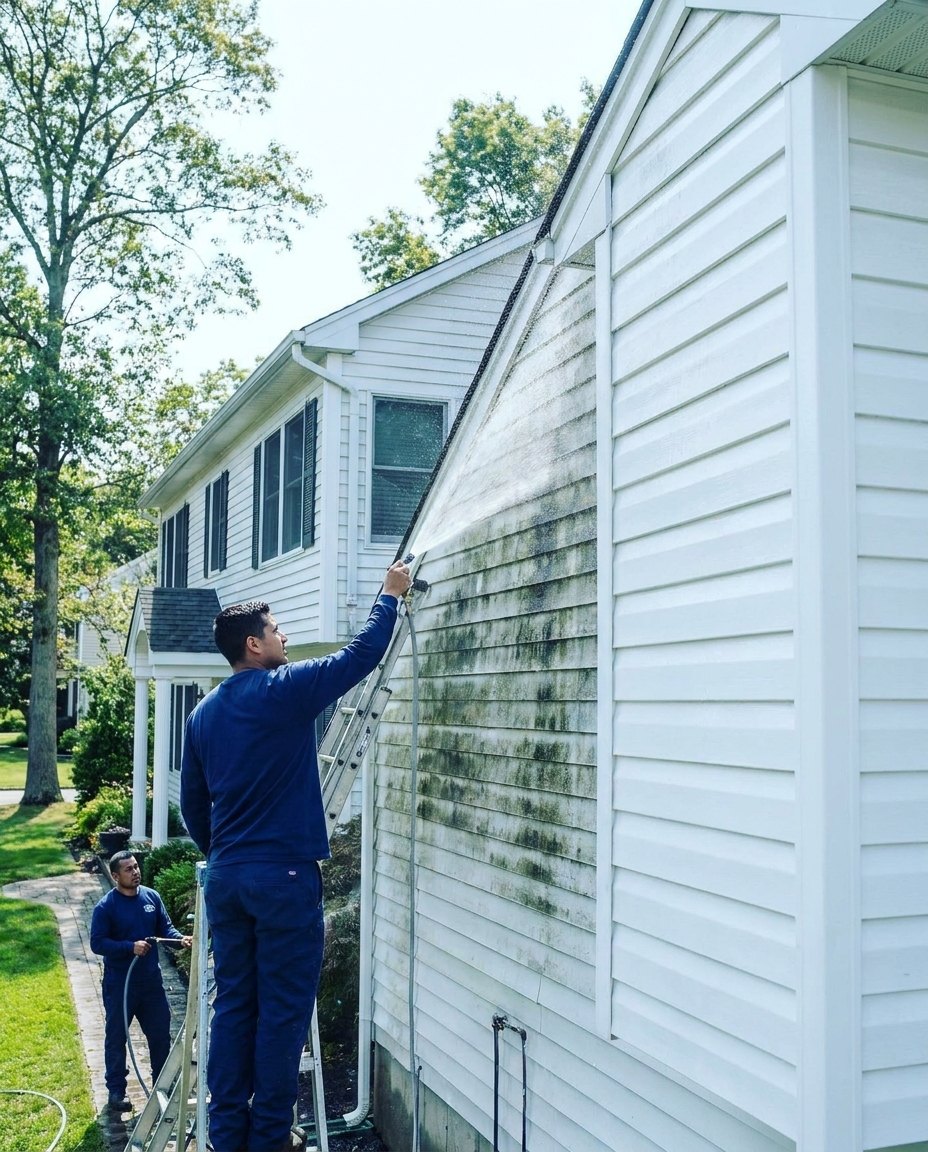
Most Long Island homes benefit from a full exterior wash once a year, but the right frequency depends on your siding, tree cover, and whether you live near the shore. Here is how to decide.
- Most Long Island houses do well with one full exterior wash per year, usually in spring or fall.
- North Shore homes under heavy tree cover often need more frequent attention for moss, algae and green streaks.
- South Shore homes deal with salt air and humidity, which speed up grime and mildew buildup.
- Soft washing, not high-pressure blasting, is the safe method for vinyl, stucco and most siding.
- Green or black streaks, chalky residue and slippery walkways are signs it is time to wash.
The short answer: about once a year
For most homes on Long Island, a full exterior wash once a year keeps siding, walkways and trim looking clean and protects the surfaces underneath. That single annual wash removes the dirt, pollen, mildew and organic growth that build up over four distinct seasons, and it does so before that buildup has a chance to stain or damage anything.
That said, once a year is a starting point, not a rule. Your ideal frequency depends on where your house sits, what it is made of, and how much shade and moisture it gets. Some homes stay clean for well over a year. Others, especially those tucked under mature oaks and maples, look green again within months. The rest of this guide helps you find your number.
North Shore vs South Shore: location changes everything
Long Island is not one climate, it is several micro-conditions packed into two counties. On the North Shore, heavy tree cover means shade, falling leaves and constant moisture on north-facing walls. That combination feeds algae, moss and the green and black streaks you see creeping up siding and down roofs. Homes here often benefit from washing a little more often, sometimes every eight to twelve months, and roof and gutter cleaning tends to be a recurring need rather than a one-time job.
On the South Shore, the story is salt air and humidity. Homes closer to the Great South Bay and the barrier beaches take a steady dose of airborne salt, which clings to siding, dulls finishes and holds moisture against the surface. Add the region's summer humidity and you get faster mildew growth on shaded walls and railings. If you live within a mile or two of the water, plan on inspecting your exterior more often and washing before grime has a chance to set.
Your siding decides the method (and the frequency)
The material on your walls matters as much as your location. Vinyl siding, the most common choice on Long Island, cleans up beautifully but should be soft washed, not blasted with high pressure that can force water behind the panels. Cleaned once a year, vinyl stays bright and mildew-free. Cedar shake and wood siding, common on classic Colonials and Capes, need a gentler touch and periodic attention, since trapped moisture and organic growth can shorten their life.
Brick and stucco are durable but not indestructible. High pressure can chip mortar or crack a stucco finish, so these also call for lower-pressure, detergent-based soft washing. Fiber cement siding, like HardiePlank, holds up well and typically needs only an annual rinse. Whatever your material, the guiding idea is the same: let the cleaning solution do the work of killing algae and mildew, and use pressure only as much as the surface can safely take.
This is exactly why a professional soft wash matters. A pro adjusts pressure, nozzle and cleaning mix to your specific siding, which protects your investment and gets a deeper, longer-lasting clean than a rented machine on a Saturday afternoon.
The best time of year to wash on Long Island
Spring and fall are the two sweet spots. A spring wash clears away the salt residue, sand and grime left by winter and the season's heavy tree pollen, so your home looks fresh heading into the warm months. It is also a smart time to catch any mildew that took hold over a damp winter. Many homeowners pair a spring house wash with driveway and walkway cleaning to reset the whole property at once.
A fall wash does the opposite favor: it strips off the summer's mildew, dirt and organic growth before winter arrives, and it clears gutters clogged with leaves before the freeze. Going into winter clean matters more than people think, because moisture and organic buildup left on siding and in gutters can freeze, expand and cause damage during a hard Long Island winter or a passing nor'easter.
You can wash in summer too, and it dries fast, but avoid pressure washing during freezing temperatures. Water in the lines and on the surface can freeze, and cleaning solutions work best in mild weather. If you only wash once a year, pick spring or fall based on which problem, winter salt or summer mildew, hits your home harder.
Signs it is time to wash right now
You do not have to wait for the calendar. Your house will tell you when it needs a wash. The clearest signal is green or black streaking on siding, which is algae and mildew, not just dirt. Left alone it spreads, digs in and gets harder to remove. Black streaks running down a roof are a related organism (often gloeocapsa magma) and a sign your roof needs attention before it damages shingles.
Other tells: a chalky film that rubs off on your hand when you touch the siding, dull or faded-looking walls that brighten dramatically once cleaned, and green or slick buildup on north-facing walls, steps and walkways. That slick film is a slip hazard, especially on shaded paths and pool decks, and it is a genuine safety reason to clean, not just a cosmetic one.
Finally, look at your gutters and the ground near your foundation. Overflowing gutters, stains streaking down from them, and moss growing at the base of walls all point to moisture that is not draining the way it should. Addressing it early with a wash and a gutter cleaning is far cheaper than repairing rot or water damage later.
What it costs and what drives the price
For a typical single-family Long Island home, a professional exterior house wash usually falls in a range of a few hundred dollars, often somewhere in the low-to-mid hundreds. The exact number depends on several real factors, and any honest local company will want to see your home or hear its details before quoting.
The main price drivers are the size and number of stories (two and three-story homes need more equipment and time), the type of siding and how delicate it is, and how heavy the buildup is. A house that has not been cleaned in years with thick algae takes more work than one on a yearly schedule. Add-ons like roof cleaning, gutter cleaning, driveways, decks and fences are usually priced separately or bundled at a discount.
One practical tip: bundling services on the same visit almost always costs less per item than booking them piecemeal, and staying on a regular wash schedule keeps each future wash easier and cheaper because grime never gets the chance to set in. Premium Services is licensed and insured and serves homeowners across Nassau and Suffolk, and can give you a straight quote based on your specific home.
Building a simple schedule for your home
Put it all together and a simple plan emerges. If your home is in an open, sunny spot with modern siding and no water nearby, once a year, in spring or fall, is likely plenty. If you are under heavy North Shore tree cover or close to the South Shore water, plan on a wash every eight to twelve months and keep an eye on roofs and gutters between visits.
Between full washes, a quick walk around the house each season goes a long way. Look at north-facing walls, shaded corners, steps and gutters, the places that stay damp and grow green first. Catching a problem early usually means a lighter, cheaper cleaning rather than a heavy restoration wash.
If you are not sure where your home falls, the easiest move is to have a local pro look at it once. Premium Services can assess your siding, exposure and buildup, recommend a realistic frequency, and set you up on a schedule so you never have to guess again. You can reach the team at (934) 500-2940 or book a visit online through the site.
Frequently asked questions
You can, but a rented machine on full pressure can crack stucco, gouge wood, and force water behind vinyl siding, which leads to mold and rot. Most siding needs a lower-pressure soft wash with the right cleaning solution, which is why many Long Island homeowners hire a pro for the whole-house job.
No. High-pressure washing relies on force and suits hard surfaces like concrete driveways. Soft washing uses low pressure plus a cleaning solution to kill algae and mildew at the root, and it is the safe method for siding, stucco, and roofs. A good company uses whichever the surface calls for.
It should not when done correctly. A professional wets down surrounding plants before and after, uses biodegradable solutions where appropriate, and protects delicate landscaping. This is another reason a trained crew is safer than a rented machine and harsh store-bought chemicals.
Most homes stay clean for roughly a year, but a shaded North Shore home under heavy trees or a humid South Shore home near the water may start showing green growth sooner. Staying on a regular schedule keeps results looking good longer and makes each wash easier.
Spring (to clear winter salt and pollen) and fall (to remove summer mildew before the freeze) are ideal. Avoid washing during freezing temperatures. If you only wash once a year, choose the season that matches your home's biggest problem.
Rather leave it to the pros?
Premium Services covers all of Long Island. Free, no-obligation estimate.
Pressure Washing near you
Get it done by a local, licensed team.