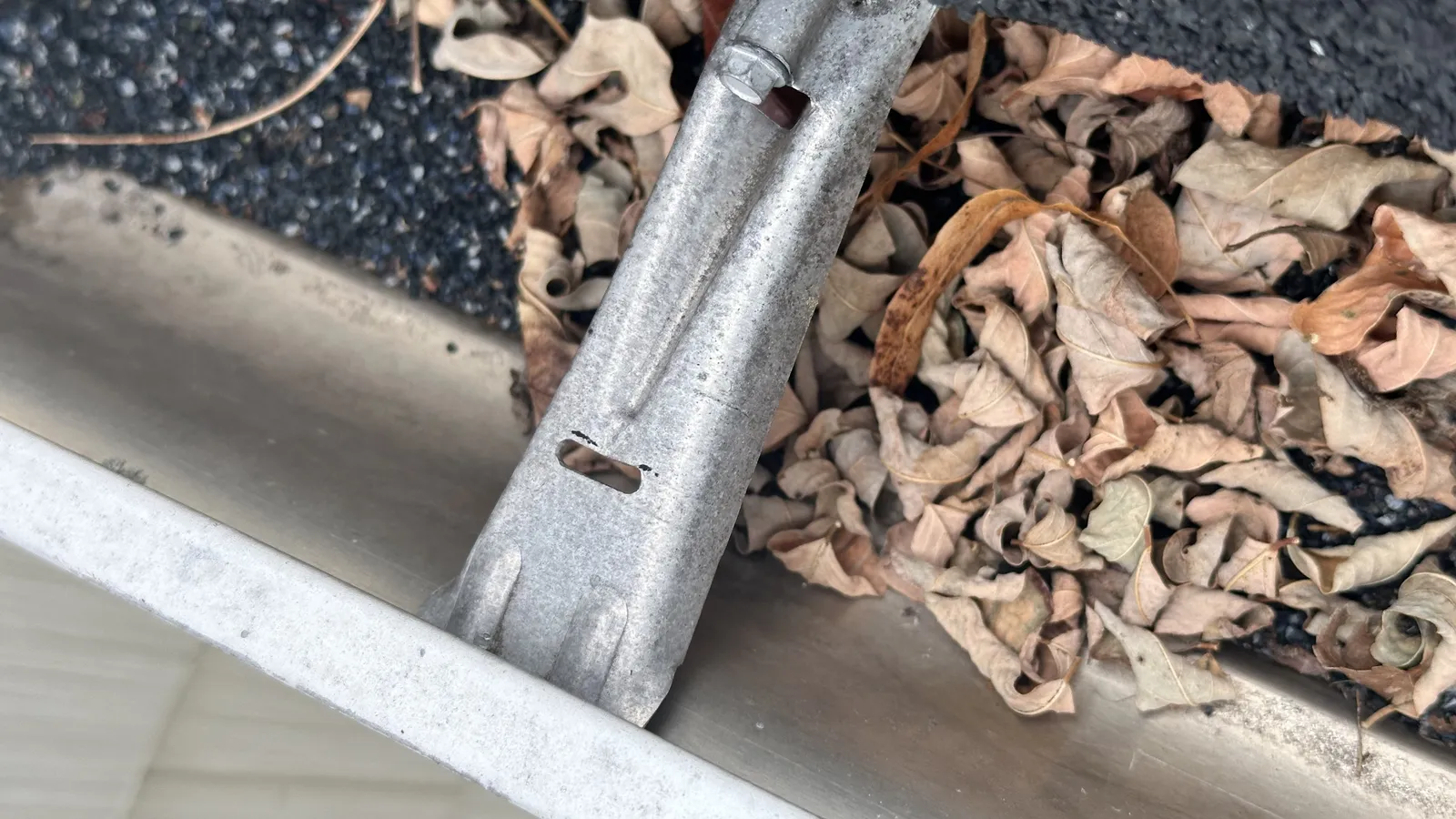
Gutters do quiet, unglamorous work until they stop. Here is what actually happens to a Long Island home when the leaves, moss and grit pile up year after year, and what it costs to fix.
- Clogged gutters overflow and push water toward your fascia, siding and foundation, which is where the expensive damage starts.
- On Long Island the two biggest triggers are North Shore tree cover and winter ice dams from backed-up gutters.
- Cleaning costs far less than a single roof, basement or foundation repair, so it is one of the best maintenance bargains you can buy.
- Most homes here need cleaning twice a year, in late spring and again in late fall after the leaves drop.
- If you already see stains, sagging or plant growth in the gutters, the system is failing now and needs attention soon.
What gutters actually do (and why neglect adds up)
Your gutters have one job: catch the water running off your roof and carry it away from the house through the downspouts. A typical Long Island roof sheds hundreds of gallons during a single heavy rain, and a nor'easter can dump several inches in a day. When the gutters are clear, all of that water lands a safe distance from your walls and foundation. When they are clogged, it has nowhere to go but over the edge and straight down against the house.
The damage from neglect is rarely dramatic on day one. It builds slowly and quietly, one rainstorm at a time, until a small problem you could have cleaned away for a modest fee becomes a repair that runs into the thousands. That is the real risk of never cleaning your gutters. You are not gambling on one bad storm, you are letting water work against the most expensive parts of your home month after month.
Understanding what fails, and in what order, makes it easy to see why regular cleaning is worth it. Here is what actually happens as the debris piles up.
Water damage to fascia, soffits and siding
The first casualty is usually the wood right behind and below the gutter. When a clogged gutter overflows, water runs down the fascia board (the trim the gutter is attached to) and soaks the soffit underneath. On the classic Cape Cods, colonials and split-levels common across Nassau and Suffolk, that trim is often wood, and wood that stays wet begins to rot.
Once the fascia softens, the gutter itself loses its solid anchor and starts to pull away or sag. Water then finds its way behind the siding and into the wall cavity, where it can quietly feed mold and ruin insulation long before you notice a stain on an interior wall. On the humid South Shore, where salt air already accelerates corrosion and wear, this process moves faster than most homeowners expect.
None of this announces itself. By the time you see peeling paint, a dark streak on the fascia or a soft spot in the soffit, the repair has grown from a cleaning into carpentry.
Foundation cracks, basement flooding and erosion
When gutters overflow, water dumps in a concentrated line along the base of the house instead of being carried away by the downspouts. Over time that pooling water saturates the soil against your foundation. In cold months it freezes and expands, and that pressure can crack concrete and open gaps in the foundation wall.
Those cracks and saturated soil are the leading cause of wet basements and crawl spaces. Plenty of Long Island homes have a finished basement or a slab that sits close to a high water table, so it does not take much extra water to cause a problem. What began as leaves in a gutter can end as a flooded basement, a failing sump pump and thousands of dollars in cleanup and waterproofing.
The overflow also erodes whatever it lands on: garden beds wash out, mulch floats away, and walkways and driveways can settle or crack as the ground beneath them shifts. Directing roof water where it belongs is far cheaper than repairing the ground and structure after the fact.
Ice dams and winter damage
Long Island winters make neglected gutters especially risky. When a gutter is packed with debris, meltwater cannot drain. It sits, refreezes at the roof edge, and builds an ice dam. That ridge of ice traps more meltwater behind it, and the backed-up water works its way under the shingles and into the roof deck, attic and ceilings.
Ice dams are one of the most common winter insurance claims in the Northeast, and clogged gutters are a frequent contributor. The heavy ice and frozen debris also add serious weight, which can bend gutters, tear brackets loose and pull sections off the fascia entirely. A single hard freeze on top of a clogged system can undo a season of neglect in one night.
Clean gutters will not prevent every ice dam on their own, since attic insulation and ventilation matter too, but a clear, free-draining gutter removes one of the biggest and easiest-to-fix causes going into winter.
Pests, mosquitoes, moss and roof rot
A gutter full of wet leaves is a ready-made habitat. Standing water becomes a breeding ground for mosquitoes, which matters in a region where mosquito season runs all summer. The damp, decomposing debris also attracts carpenter ants, and it gives birds, squirrels and other rodents a soft, sheltered place to nest right against your roofline.
The North Shore's heavy tree canopy adds another problem: shade and constant moisture encourage moss and algae. Seeds that settle in the muck actually sprout, and it is common to find small maple seedlings or grass growing out of a long-neglected gutter. All of that organic matter holds water against the roof edge and the fascia, which speeds up shingle deterioration and wood rot.
Left long enough, the same conditions that rot the fascia can reach the lower courses of shingles and the roof deck itself. Roof repairs are among the most expensive fixes a homeowner faces, which is a big part of why gutter cleaning pays for itself.
What it costs, and how often to clean on Long Island
Professional gutter cleaning is one of the more affordable services a homeowner buys. For a typical single-family Long Island home, most cleanings fall in a range of roughly one hundred fifty to three hundred dollars, though larger homes, three-story houses, steep roofs, heavy tree debris and add-ons like downspout flushing can push it higher. The main things that drive price are the linear footage of gutter, the height and pitch of the roof, how much debris has built up, and access.
For frequency, most homes here do well with two cleanings a year: once in late spring after the trees finish dropping seeds and pollen, and once in late fall after the leaves come down. If your house sits under mature oaks, maples or pines, especially on the North Shore, you may want a third visit or a mid-season check, because those trees can clog a gutter surprisingly fast.
Compare a couple of routine cleanings a year to the cost of new fascia, a waterproofed basement or a roof repair, and the math is not close. This is exactly the kind of local, unglamorous work that Premium Services handles for Nassau and Suffolk homeowners, and keeping it on a schedule is the whole point. If you cannot remember the last time your gutters were cleared, that is usually a sign the next storm will find the weak spot.
Warning signs your gutters need attention now
You do not always have to climb a ladder to know your gutters are failing. During a good rain, look for water sheeting over the front edge of the gutter or spilling from the seams instead of running out the downspouts. That overflow is the clearest sign the channel is blocked.
From the ground, watch for gutters that sag or pull away from the fascia, dark streaks or peeling paint on the trim below them, pooling water or eroded soil along the foundation after storms, and any plants, grass or seedlings growing out of the gutter line. Inside, a damp basement smell or new water stains on upper-floor ceilings can trace back to the same source.
If you notice any of these, the system is already backing water up against your home. Getting it cleared and inspected before the next heavy storm or the first hard freeze is the cheapest move you can make. You can reach Premium Services at (934) 500-2940 or book online through the site to get on a regular schedule before small problems turn into big ones.
Frequently asked questions
Most homes here need cleaning twice a year, in late spring and late fall. If your house sits under mature oaks, maples or pines, especially on the North Shore, a third visit or a mid-season check is a good idea.
Yes. Overflow dumps water in a concentrated line along the base of the house, saturating the soil. That water can seep into the basement and, when it freezes and expands in winter, crack the foundation wall.
For a typical Long Island single-family home, most cleanings run roughly one hundred fifty to three hundred dollars. Larger or taller homes, steep roofs, heavy debris and downspout flushing can push the price higher.
DIY is possible on a single-story home if you are comfortable and safe on a ladder, but two-story houses, steep roofs and winter conditions make it risky. A pro also spots early problems like loose brackets or rotting fascia before they get expensive.
Rather leave it to the pros?
Premium Services covers all of Long Island. Free, no-obligation estimate.
Roof & Gutters near you
Get it done by a local, licensed team.