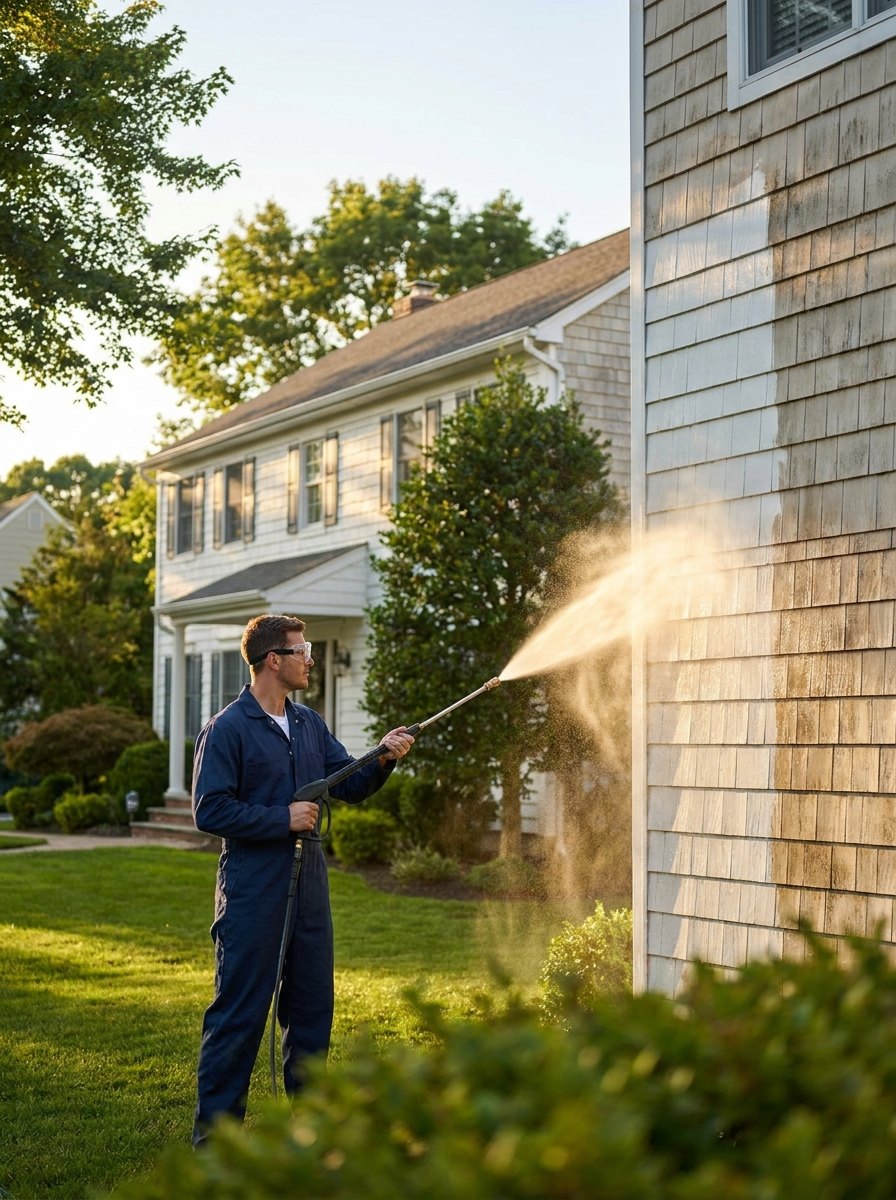
Long Island falls are short, and the tasks you skip in October you pay for in January. This checklist walks you through the exterior work that protects your home before the first nor'easter.
- Clean gutters and downspouts after most leaves drop, usually late October into November.
- Inspect the roof for loose shingles, moss and flashing gaps before winter storms arrive.
- Seal gaps, disconnect hoses and protect outdoor faucets to prevent frozen, burst pipes.
- South Shore homes fight salt air and humidity; North Shore homes fight tree debris and moss.
- Booking exterior cleaning early in fall means better availability and better weather windows.
Why fall maintenance matters more on Long Island
Long Island gets all four seasons, and the transition from fall to winter is where homes take the most quiet damage. Warm, humid days give way to freezing nights, heavy rain, and the occasional nor'easter that dumps water and wind on your roof and siding at the same time. Small problems that were harmless in September, like a clogged gutter or a hairline gap around a window, become expensive once water freezes and expands inside them.
Geography matters here too. If you live on the North Shore, think Huntington, Oyster Bay or the wooded parts of Suffolk, your biggest fall enemy is organic debris: falling leaves, acorns, and the moss and algae that thrive under heavy tree cover. On the South Shore, from Long Beach to the Great South Bay towns, salt air and humidity are constant, and they leave a grimy film on siding and speed up corrosion on metal fixtures.
The point of a fall checklist is simple. You are closing your home up for the hardest three months of the year, so you want water flowing away from the house, gaps sealed, and surfaces clean before the cold locks everything in place.
Gutters and downspouts: the number one fall task
Clogged gutters are the single most common cause of preventable winter damage on Long Island. When leaves pack a gutter, rainwater and snowmelt have nowhere to go, so they spill over the edge, soak your fascia boards, and pool against the foundation. In freezing weather that trapped water forms ice dams along the roof edge, which push meltwater back up under your shingles and into the attic.
Timing is everything. If you clean too early, a second wave of leaves fills the gutters again by December. On most Long Island properties the sweet spot is late October into mid November, once the bulk of the leaves have dropped. Flush the downspouts with a hose to confirm water runs freely, and make sure the discharge points several feet away from the foundation, not right beside it.
If your home sits under mature oaks or maples, or the roof is steep and two stories up, this is a job worth handing off. A professional exterior cleaning crew like Premium Services can clear the gutters, flush the downspouts and spot early roof issues in one visit, which is safer than balancing on a wet ladder in November.
Roof, chimney and flashing inspection
Your roof takes the full force of winter, so fall is the time to look it over while the weather is still mild. From the ground with binoculars, or carefully from a ladder, scan for shingles that are cracked, curled, lifted or missing. Pay close attention to the flashing, the metal strips around chimneys, skylights and vent pipes, because those seams are where leaks usually start.
On shaded North Shore roofs you will often see dark streaks or green patches. That is algae and moss, and it is not just cosmetic. Moss holds moisture against the shingles and works its way under them, shortening the roof's life. A gentle, low pressure roof cleaning handled by professionals removes it without stripping the protective granules, which is exactly what aggressive high pressure washing would do to asphalt shingles.
If you have a chimney, check that the cap and crown are intact and that no gaps have opened around the base. A quick fall inspection is cheap insurance. Finding one lifted shingle in October costs far less than discovering a stained ceiling after a January thaw.
Siding, windows and sealing out the cold
Walk the perimeter of your home and look at the siding, whether it is vinyl, cedar shake, or the brick and stucco you see on many older Long Island colonials and capes. You are checking for cracks, loose panels, and the green or gray film that builds up on north facing walls and anywhere salt air settles. A soft wash, which uses low pressure and cleaning solution rather than brute force, lifts that grime safely and keeps mold from taking hold over the winter.
Next, work on sealing. Run your hand around windows and doors on a breezy day to feel for drafts, and inspect the caulk lines. Old caulk cracks and pulls away, letting cold air and moisture in. Re-caulk gaps, add or replace weatherstripping, and check that dryer vents and other wall penetrations are sealed. This is one of the cheapest upgrades you can make and it shows up directly on your heating bill.
Do not forget the small openings. Gaps around cables, pipes and foundation vents are exactly where mice and other pests try to move in when the temperature drops. A few dollars of sealant and steel wool in the fall saves you a much bigger headache later.
Drainage, driveways and outdoor plumbing
Water is the enemy in winter, and freezing water is worse. Before the first hard freeze, disconnect and drain your garden hoses, shut off the water to exterior faucets if you have interior valves, and install inexpensive foam covers over outdoor spigots. A hose left connected can trap water in the faucet, and when it freezes it can crack the pipe inside your wall, a repair that runs into the hundreds or more.
Look at how water moves around your property. The grade should slope away from the foundation, and downspout extensions should carry water well clear of the house. Standing water that freezes near the foundation or on a walkway becomes both a structural risk and a slip hazard. Clear any leaves and debris out of yard drains and window wells so melt water has a path to escape.
Fall is also the right time to clean and seal a concrete or paver driveway. Removing built up dirt, oil and organic stains before winter, and applying sealer where appropriate, helps the surface resist the freeze and thaw cycles and the road salt that chews up Long Island driveways every year. A professional pressure washing service can prep these surfaces quickly and correctly.
Yard, trees and preparing for storms
Long Island's fall and winter storms, including the nor'easters that roll up the coast, bring strong wind that turns weak branches into projectiles. Walk your yard and look up. Any dead, cracked or overhanging limbs near the roof, the driveway or power lines should be trimmed or removed before storm season. This is one task where hiring a licensed tree service is worth it for anything large or close to wires.
Rake and remove heavy leaf piles from the lawn so the grass can breathe through winter, and store away or cover patio furniture, grills and cushions. Drain and coil hoses, bring in ceramic pots that can crack in the freeze, and secure or store anything light enough to blow around in a windstorm.
Finally, take care of the seasonal extras while a crew is already at your home. Fall is when many Long Island homeowners book Christmas light installation, and having it done alongside your gutter and exterior cleaning means the ladder work happens once, safely, before the ice arrives.
Frequently asked questions
Aim for mid October through November, after most leaves have fallen but before the first hard freeze. Gutter cleaning in particular works best once the trees are mostly bare, typically late October into mid November on Long Island.
Prices vary with the size of your home, its height, roof pitch and how much debris has built up. Gutter cleaning on a typical single family home often falls in the low to mid hundreds, while whole house soft washing depends on square footage and access. The honest answer is that a quick on site look gives the most accurate quote.
It is not recommended. High pressure strips the protective granules off asphalt shingles and can force water under them. Roofs should be cleaned with a low pressure soft wash method, which is safer for the shingles and for you, since climbing a wet or steep roof is genuinely dangerous.
Before the first hard freeze, disconnect and drain all hoses, shut off the interior valves to exterior faucets if you have them, and cover the spigots with foam insulating covers. A connected hose traps water that can freeze and crack the pipe inside your wall.
Rather leave it to the pros?
Premium Services covers all of Long Island. Free, no-obligation estimate.